
Chromatography PMMA Microspher
Biovanix PM ion exchange chromatography media utilizes a hydrophilic polymethyl methacrylate (PMMA) as its matrix with a particle diameter of 70μm. It provides a selection of various pore sizes, enabling precise control over the pore diameter of the chromatographic medium and overcoming the limitations of traditional chromatographic media. The medium features exclusive surface modification techniques that covalently bind different ion exchange functional groups onto the hydrophilic matrix surface, yielding four types of chromatographic media: strong cation exchange (SP), strong anion exchange (Q), weak cation exchange (CM), and weak anion exchange (DEAE). This ensures a high density and uniformity of the ion exchange layer.
Advantage:
- Large molecules or viral particles can effortlessly penetrate the pores for binding;
- The structure of proteins is preserved without unfolding effects; the integrity of viral capsids is maintained;
- After hydrophilic modification of the microsphere surface, ion exchange groups are covalently bonded, leading to minimal non-specific adsorption and enhanced mechanical strength;
- Improved pore permeability allows for faster molecular mass transfer, increasing the load capacity by more than tenfold;
- Significantly enhanced thermal stability of viral adsorption on the medium reduces viral degradation, resulting in a higher yield.
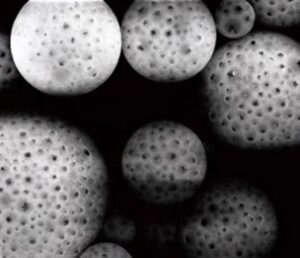
PMMA Partikelauswahl
| Produkt | PM 70S | |||
| Matrix | SP | Q | CM | DEAE |
| Partikelgröße | PMMA | |||
| Funktionsgruppe | 70 µm | |||
| Porengröße | 100 nm | |||
| Ligandenkonzentration | 0,18 meq/mL | 0,12 mÄq/ml | 0,21 meq/ml | 0,15 mÄq/ml |
| Kapazität | 115 mg Lys | 80mg BSA | 105 mg Lys | 80mg BSA |
| Durchflussmenge | 150~750 cm/h | |||
| Maximaler Druck | 1,0 MPa | |||
| PHP-Stabilität | 2-12 | |||
| Chemische Beständigkeit | Alle gängigen Puffer, 1 M Essigsäure, 1 M Natriumoxychlorid, 1 M Salzsäure, 70% Ethanol, 30% Isopropylalkohol, 30% Acetonitril, 1%SDS, 6 M Guanidinhydrochlorid, 8 M Harnstoff und andere häufig verwendete organische Lösungsmittel; Vermeiden Sie den Kontakt mit starken Oxidationsmitteln. | |||
| Betriebstemperatur | 4-30°C | |||
| Lagerung | 2–30 °C, 20% Ethanol | |||
| Produkt | PM 70M | |||
| Matrix | SP | Q | CM | DEAE |
| Partikelgröße | PMMA | |||
| Funktionsgruppe | 70 µm | |||
| Porengröße | 100–150 nm | |||
| Ligandenkonzentration | 0,15 mÄq/ml | 0,12 m Äq/ml | 0,22 meq/ml | 0,11 mÄq/ml |
| Kapazität | 115 mg Lys | 80m g BSA | 105mg Lys | 80mg BSA |
| Durchflussmenge | 150~750 cm/h | |||
| Maximaler Druck | 0,8 MPa | |||
| PHP-Stabilität | 2-12 | |||
| Chemische Beständigkeit | Alle gängigen Puffer, 1 M Essigsäure, 1 M Natriumoxychlorid, 1 M Salzsäure, 70% Ethanol, 30% Isopropylalkohol, 30% Acetonitril, 1%SDS, 6 M Guanidinhydrochlorid, 8 M Harnstoff und andere häufig verwendete organische Lösungsmittel; Vermeiden Sie den Kontakt mit starken Oxidationsmitteln. | |||
| Betriebstemperatur | 4-30°C | |||
| Lagerung | 2–30 °C, 20% Ethanol | |||
| Produkt | PM 70G | |||
| Matrix | SP | Q | CM | DEAE |
| Partikelgröße | PMMA | |||
| Funktionsgruppe | 70 µm | |||
| Porengröße | 150-300 nm | |||
| Ligandenkonzentration | 0,11 mÄq/ml | 0,12 mÄq/ml | 0,10 mÄq/ml | 0,09 meq/ml |
| Kapazität | 70 mg Lys | 75mg BSA | 70 mg Lys | 60 mg BSA |
| Durchflussmenge | 150~750 cm/h | |||
| Maximaler Druck | 0,5 MPa | |||
| PHP-Stabilität | 2-12 | |||
| Chemische Beständigkeit | Alle gängigen Puffer, 1 M Essigsäure, 1 M Natriumoxychlorid, 1 M Salzsäure, 70% Ethanol, 30% Isopropylalkohol, 30% Acetonitril, 1%SDS, 6 M Guanidinhydrochlorid, 8 M Harnstoff und andere häufig verwendete organische Lösungsmittel; Vermeiden Sie den Kontakt mit starken Oxidationsmitteln. | |||
| Betriebstemperatur | 4-30°C | |||
| Lagerung | 2–30 °C, 20% Ethanol | |||
| Produkt | PM 70G | |||
| Matrix | SP | Q | CM | DEAE |
| Partikelgröße | PMMA | |||
| Funktionsgruppe | 70 µm | |||
| Porengröße | 150-300 nm | |||
| Ligandenkonzentration | 0,11 mÄq/ml | 0,12 mÄq/ml | 0,10 mÄq/ml | 0,09 mÄq/ml |
| Kapazität | 70 mg Lys | 75mg BSA | 70m g Lys | 60 mg BSA |
| Durchflussmenge | 150~750 cm/h | |||
| Maximaler Druck | 0,5 MPa | |||
| PHP-Stabilität | 2-12 | |||
| Chemische Beständigkeit | Alle gängigen Puffer, 1 M Essigsäure, 1 M Natriumoxychlorid, 1 M Salzsäure, 70% Ethanol, 30% Isopropylalkohol, 30% Acetonitril, 1%SDS, 6 M Guanidinhydrochlorid, 8 M Harnstoff und andere häufig verwendete organische Lösungsmittel; Vermeiden Sie den Kontakt mit starken Oxidationsmitteln. | |||
| Betriebstemperatur | 4-30°C | |||
| Lagerung | 2–30 °C, 20% Ethanol | |||
| Produkt | PM 70V | |||
| Matrix | SP | Q | CM | DEAE |
| Partikelgröße | PMMA | |||
| Funktionsgruppe | 70 µm | |||
| Porengröße | 300-400 nm | |||
| Ligandenkonzentration | 0,11 mÄq/ml | 0,12 mÄq/ml | 0,10 mÄq/ml | 0,09 mÄq/ml |
| Kapazität | 70 mg Lys | 75mg BSA | 70m g Lys | 60 mg BSA |
| Durchflussmenge | 150~750 cm/h | |||
| Maximaler Druck | 0,5 MPa | |||
| PHP-Stabilität | 2-12 | |||
| Chemische Beständigkeit | Alle gängigen Puffer, 1 M Essigsäure, 1 M Natriumoxychlorid, 1 M Salzsäure, 70% Ethanol, 30% Isopropylalkohol, 30% Acetonitril, 1%SDS, 6 M Guanidinhydrochlorid, 8 M Harnstoff und andere häufig verwendete organische Lösungsmittel; Vermeiden Sie den Kontakt mit starken Oxidationsmitteln. | |||
| Betriebstemperatur | 4-30°C | |||
| Lagerung | 2–30 °C, 20% Ethanol | |||
 English
  العربية
  Français
  Deutsch (Sie)
  한국어
한국어  Русский
  Español de Argentina