
Chromatography PSDVB Microspher
Biovanix offers ion exchange chromatography media based on a polymer matrix of PSDVB (styrene-divinylbenzene copolymer). After undergoing surface hydrophilic modification, ion exchange groups are covalently bonded. This medium has low non-specific adsorption, high mechanical strength, and is biocompatible with biologically active macromolecules, ensuring chemical stability and significantly improving purification efficiency.
The enhanced Poly50 matrix features superior mechanical resilience, chemical stability, and an open porous structure, with selections available for standard, large, and super-large pores. The surface is modified to be hydrophilic, reducing non-specific adsorption, and is designed for high flow rates, high resolution, and increased loading capacity. It is well-suited for separating and purifying biological macromolecules including monoclonal antibodies, viruses, and vaccines.
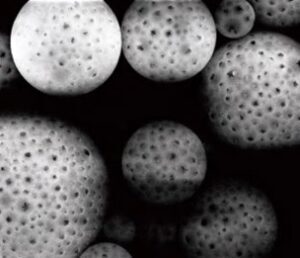
PS-DVB Partikelauswahl
| Produkt | Poly15 SP | Poly15 Q | Poly30 SP | Poly30 Q |
| Matrix | Monodisperses PS-DVB | |||
| Partikelgröße | 15 µm | 30 µm | ||
| Funktionsgruppe | (-CH2)SO3- | -CH2N+(CH3)3 | (-CH2)SO3- | -CH2N+(CH3)3 |
| Ligandenkonzentration | 0,22 milläquivalente/ml | 0,24 mÄq/ml | 0,15 mÄq/ml | 0,18 mÄq/ml |
| Kapazität | 80mg Lys/mL | 45 mg BSA/ml | 60 mg Lys/mL | 30mg BSA/ml |
| Durchflussmenge | 150-800 cm/h | 250–1000 cm/h | ||
| Max. Druck | 8,0 MPa | 5.0MPa | ||
| PHP-Stabilität | 2-12 | |||
| Chemische Beständigkeit | Alle gängigen Puffer, 1 M Essigsäure, 1 M Natriumoxychlorid, 1 M Salzsäure, 70% Ethanol, 30% Isopropylalkohol, 30% Acetonitril, 1%SDS, 6 M Guanidinhydrochlorid, 8 M Harnstoff sowie andere häufig verwendete organische Lösungsmittel; Vermeiden Sie den Kontakt mit starken Oxidationsmitteln. | |||
| Betriebstemperatur | 4-30°C | |||
| Lagerung | 2–30 °C, 20% Ethanol | |||
| Produkt | Poly 50M | |||
| Matrix | SP | Q | CM | DEAE |
| Partikelgröße | PS-DVB | |||
| Funktionsgruppe | 50um | |||
| Porengröße | 100–150 nm | |||
| Ligandenkonzentration | 0,15 mÄq/ml | 0,16 meq/ml | 0,15 mg/ml | 0,16 mg/ml |
| Kapazität | >80mgLys | >100mg Rinderserumalbumin | >80mgLys | >90mg BSA |
| Durchflussmenge | 300–1200 cm/h | |||
| Maximaler Druck | 3,0 MPa | |||
| PHP-Stabilität | 1-12 | |||
| Chemische Beständigkeit | Alle gängigen Puffer, 1 M Essigsäure, 1 M Natriumoxychlorid, 1 M Salzsäure, 70% Ethanol, 30% Isopropylalkohol, 30% Acetonitril, 1%SDS, 6 M Guanidinhydrochlorid, 8 M Harnstoff und andere häufig verwendete organische Lösungsmittel; Vermeiden Sie den Kontakt mit starken Oxidationsmitteln. | |||
| Betriebstemperatur | 4-30°C | |||
| Lagerung | 2–30 °C, 20% Ethanol | |||
| Produkt | Poly 50G | |||
| Matrix | SP | SP | SP | SP |
| Partikelgröße | PS-DVB | |||
| Funktionsgruppe | 50um | |||
| Porengröße | 150-300 nm | |||
| Ligandenkonzentration | 0,14 mg/ml | 0,14 mg/ml | 0,14 mg/ml | 0,14 mg/ml |
| Kapazität | >70mg Lys | >70mg Lys | >70mg Lys | >70mg Lys |
| Durchflussmenge | 300–1200 cm/h | |||
| Maximaler Druck | 2,0 MPa | |||
| PHP-Stabilität | 1-12 | |||
| Chemische Beständigkeit | Alle gängigen Puffer, 1 M Essigsäure, 1 M Natriumoxychlorid, 1 M Salzsäure, 70% Ethanol, 30% Isopropylalkohol, 30% Acetonitril, 1%SDS, 6 M Guanidinhydrochlorid, 8 M Harnstoff und andere häufig verwendete organische Lösungsmittel; Vermeiden Sie den Kontakt mit starken Oxidationsmitteln. | |||
| Betriebstemperatur | 4-30°C | |||
| Lagerung | 2–30 °C, 20% Ethanol | |||
| Produkt | Poly 50V | |||
| Matrix | SP | SP | SP | SP |
| Partikelgröße | PS-DVB | |||
| Funktionsgruppe | 50um | |||
| Porengröße | 300-400 nm | |||
| Ligandenkonzentration | 0,12 ME pro ml | 0,12 ME pro ml | 0,12 ME pro ml | 0,12 ME pro ml |
| Kapazität | >70mg Lys | >70mg Lys | >70mg Lys | >70mg Lys |
| Durchflussmenge | 300–1200 cm/h | |||
| Maximaler Druck | 1,0 MPa | |||
| PHP-Stabilität | 1-12 | |||
| Chemische Beständigkeit | Alle gängigen Puffer, 1 M Essigsäure, 1 M Natriumoxychlorid, 1 M Salzsäure, 70% Ethanol, 30% Isopropylalkohol, 30% Acetonitril, 1%SDS, 6 M Guanidinhydrochlorid, 8 M Harnstoff und andere häufig verwendete organische Lösungsmittel; Vermeiden Sie den Kontakt mit starken Oxidationsmitteln. | |||
| Betriebstemperatur | 4-30°C | |||
| Lagerung | 2–30 °C, 20% Ethanol | |||
 English
  العربية
  Français
  Deutsch (Sie)
  한국어
한국어  Русский
  Español de Argentina