
Core-Shell Technology for Virus Purification
Resina de cromatografía InertShell Core-Shell
Para la purificación de Adenoviridae ADV
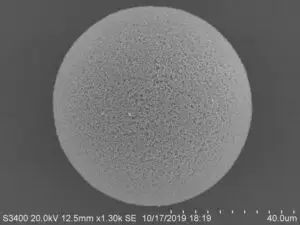
Resina de cromatografía Biovanix InertShell is a revolutionary core-shell technology-based resin designed for the purification of viruses and large biomolecules. Combining size-exclusion separation with binding chromatography, this advanced resin efficiently captures and isolates large biomolecules while allowing smaller contaminants to pass through and bind within the core.
This dual functionality ensures high-purity outcomes in downstream processing.
20 mg/mL
BSA Binding Capacity
≤1,0 MPa
Presión máxima
pH 3–13
Wide pH Stability
30+
Reuse Cycles
How It Works
Dual-Function Core-Shell Architecture
Combining size-exclusion and binding chromatography in a single resin for unmatched purification efficiency.
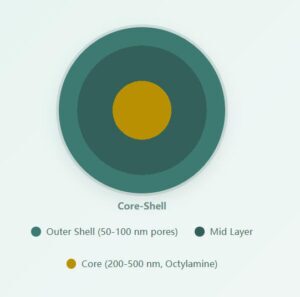
Size-Exclusion + Binding in One Step
The outer shell is hydrophilic and neutral with 50-100 nm pores. Large biomolecules (e.g., inactivated viruses) are too large to penetrate the shell and are collected directly in the flow-through fraction (FT mode).
Smaller contaminants (<700 kDa) diffuse through the shell into the macroporous core (200-500 nm), where octylamine ligands provide both anion exchange and hydrophobic interaction to capture and retain impurities.
Key advantage: The thinner shell layer (0.5-1.0 μm vs. competitor’s 5 μm) enables faster mass transfer of impurities to the core for capture, resulting in higher yield of impurity removal and more efficient CIP cleaning.
Características del producto
Designed for Demanding Biopurification
Four key capabilities that set InertShell apart in virus and biomolecule downstream processing.
🔬 Core-Shell Technology
- Doble funcionalidad: Realiza simultáneamente la separación por exclusión de tamaño y la cromatografía de unión.
- Separación eficaz: Las biomoléculas grandes (por ejemplo, virus inactivados) se recogen en la fracción de flujo continuo (modo FT), mientras que los contaminantes (<700 kDa) se unen a los ligandos internos.
- Diseño optimizado: La cubierta exterior es hidrófila y neutra, lo que evita interacciones no deseadas y garantiza elevados caudales.
⚗️ Advanced Material Composition
- Base de polímero: Fabricado con microesferas de metacrilato polimérico para una mayor durabilidad y estabilidad química.
- Ligando activo: El ligando de octilamina en el núcleo proporciona capacidades tanto de intercambio aniónico como de interacción hidrofóbica.
- Estructura porosa: La cáscara tiene un tamaño de poro de 50-100 nm, mientras que el núcleo oscila entre 200-500 nm, lo que garantiza una separación eficaz en función del tamaño molecular.
✨ High Purity and Efficiency
- Captura selectiva: Elimina eficazmente impurezas como proteínas de células huésped, fragmentos de ADN, endotoxinas y albúmina.
- Alta capacidad: Diseñada para gestionar procesos de purificación a gran escala con gran eficacia y escalabilidad.
🛡️ Compliance and Safety
- Derivado no animal: Manufactured using synthetic processes, ensuring compliance with regulatory standards and ethical requirements.
- Rendimiento estable: Fiabilidad en varias escalas de producción, lo que garantiza resultados uniformes.
Technical Specifications
Complete Product Specifications
Detailed technical data for method development, validation, and process integration.
| Característica | Descripción |
|---|---|
| Matriz de apoyo | Poli(estireno-divinilbenceno) reticulado |
| Tamaño medio de las partículas | 50-150 μm |
| Tamaño medio de los poros | 200 nm (core); 50-100 nm (shell) |
| Funcionalidad de la superficie | poly(dT) 25mer con enlazador patentado |
| Densidad del ligando | 0,10-0,20 mmol/mL |
| Resistencia mecánica | 70 bar (1.000 psi; 7 MPa) |
| Estabilidad térmica | Allows sample denaturing at 65°C if needed |
| Rango de pH | 2-13 |
| Gama de fuerza iónica | 0 a 5 M, todas las sales comunes |
| Resistencia química | Common agents for mRNA purification, include 0.5 M NaOH, 2 M MgCl₂, 20 mM EDTA. Water, 0 to 100% alcohol, acetonitrile, 2 M acetic acid, 1 M HCl, and other common organic solvents |
| Almacenamiento | 18-20% etanol |
Competitive Edge
Biovanix InertShell vs. Competitor 700
Direct performance comparison demonstrates clear advantages across key parameters.
| Carcasa inerte Biovanix | Competidor 700 | |
| Matriz | Poliacrilato | Agarosa altamente reticulada |
| Ligando | Octilamina | Octilamina |
| Tamaño medio de las partículas | 50-150 μm | 50-150 μm |
| Densidad del ligando | 0,10-0,20 mmol/mL | 0,04-0,085 mmol/mL |
| Capacidad de encuadernación¹ | 20 mg BSA/mL resina | 12 mg BSA/mL resina |
| Presión operativa | ≤1,0 MPa | ≤0,3 MPa |
| Caudal operativo | 100-600 cm/h | 100-600 cm/h |
| Estabilidad del pH | 3-13 | 3-13 |
| Temperatura | 4-30℃ | 4-30℃ |
| Estabilidad química | Todos los tampones acuosos utilizados habitualmente, hidróxido de sodio (NaOH)² 1 M, clorhidrato de guanidina 6 M, isopropanol 30% y etanol 70%. | |
| Almacenamiento | 20% etanol a 4°C a 25 ℃. | |
- Capacidad de unión dinámica medida a 5% de avance con 76 cm/h en columnas de φ10×13 mm, 1 mL. El tampón fue 1,0 mg/mL BSA 50 mM NaCl, pH 0.
- No se produjeron cambios significativos en la capacidad iónica ni en el contenido de carbono tras un almacenamiento de 1 semana en NaOH 1 M a 25°C.
2.5×
1.67×
3.3×
Thinner Shell, Faster Mass Transfer
Compared with Competitor 700, the thickness of the core in Biovanix InertShell (0.5-1.0 μm) is significantly smaller than Competitor 700 (5 μm). This thinner shell is conducive to the rapid mass transfer of impure proteins to the medium core for capture, including host cell proteins, DNA fragments, endotoxin, and serum. Biovanix InertShell delivers a higher yield of impurity removal. With the macroporous structure (200-500 nm) of the core, InertShell can quickly remove captured impurities during CIP, and demonstrates a longer service life — in animal vaccine studies, consistent performance for more than 30 reuse cycles.
Resumen de prestaciones
Why Biovanix InertShell Resin
Purpose-built for high-purity virus and biomolecule downstream processing.
⚡
Alta eficacia
Purificación rápida y eficaz del ARNm.
📈
Proceso escalable
Fácilmente adaptable a la fabricación a gran escala.
🛡️
Cumplimiento de la normativa
Proceso de fabricación no derivado de animales y sintético.
💰
Rentable
La simplificación del flujo de trabajo reduce la complejidad operativa y los costes.
🔄
Long Service Life
30+ reuse cycles with consistent performance.
Aplicaciones
Built for the Future of Biopharmaceuticals
From vaccine production to gene therapy, InertShell supports your most critical purification workflows.
Purificación de virus
Aislamiento eficaz de virus inactivados para vacunas y terapias génicas.
Separación de grandes biomoléculas
Adecuado para la purificación de grandes proteínas y complejos.
Eliminación de proteínas de la célula huésped
Eliminación eficaz de las proteínas de las células huésped y otras impurezas.
Producción de vacunas
Racionalización del procesamiento posterior para vacunas de ARNm y vacunas basadas en vectores virales.
Terapia génica
Producción escalable de vectores virales para aplicaciones de terapia génica.
Why Choose Biovanix
Your Trusted Partner in Chromatography
① Enhanced Purity
Eliminación eficaz de impurezas para lograr una pureza ultraelevada en la purificación de virus y biomoléculas.
② Dual Mode Operation
Combina la cromatografía de exclusión por tamaño y de unión para un control versátil y preciso.
③ Scalable Solution
Ideal tanto para procesos de fabricación a escala de laboratorio como a gran escala.
④ Cost-Effective
Los flujos de proceso simplificados y la alta eficiencia reducen los costes operativos y mejoran la productividad.
⑤ Regulatory Compliance
La fabricación sintética y sin animales garantiza el cumplimiento de las normas biofarmacéuticas mundiales.
Frequently Asked Questions
InertShell Resin FAQ
Common questions about core-shell chromatography for virus and biomolecule purification.
What is InertShell Core-Shell Chromatography Resin and how does it work?
Biovanix InertShell is a core-shell chromatography resin designed for the purification of viruses and large biomolecules. It combines size-exclusion separation with binding chromatography in a single step. The outer shell is hydrophilic and neutral with 50-100 nm pores, while the inner core features macropores of 200-500 nm functionalized with octylamine ligands. Large biomolecules like inactivated viruses pass through in the flow-through fraction, while smaller contaminants (<700 kDa) including host cell proteins, DNA fragments, and endotoxins bind to the internal ligands.
What is the difference between core-shell and fully porous chromatography resins?
Core-shell resins feature a non-porous solid core surrounded by a thin porous outer shell. This architecture reduces mass transfer resistance compared to fully porous particles, enabling faster flow rates with lower backpressure. The reduced diffusion path means analytes spend less time diffusing in and out of pores, resulting in sharper peaks, higher resolution, and shorter processing times. Biovanix InertShell further enhances this by using a polymeric methacrylate base rather than silica, providing superior chemical stability across pH 3-13.
What applications is InertShell resin best suited for?
InertShell resin is optimized for five key applications: (1) Virus purification — efficient isolation of inactivated viruses for vaccines and gene therapies; (2) Large biomolecule separation — purification of large proteins and complexes; (3) Host cell protein (HCP) removal — efficient elimination of HCPs and other process impurities; (4) Vaccine production — streamlined downstream processing for mRNA vaccines and viral vector-based vaccines; (5) Gene therapy — scalable production of viral vectors. It is particularly suited for adenovirus (ADV) purification.
How does InertShell compare to competing core-shell resins?
Compared to Competitor 700 (agarose-based), Biovanix InertShell offers several advantages: (1) 1.67× higher binding capacity (20 mg BSA/mL vs. 12 mg BSA/mL); (2) 3.3× higher operational pressure tolerance (1.0 MPa vs. 0.3 MPa); (3) 2.5× higher ligand density (0.10-0.20 mmol/mL vs. 0.04-0.085 mmol/mL); (4) Thinner shell layer (0.5-1.0 μm vs. 5 μm) enabling faster mass transfer of impurities to the core for capture; (5) Polymeric methacrylate base provides greater chemical stability than agarose; (6) Demonstrated reusable performance of 30+ cycles with minimal property changes in animal vaccine applications.
What is the recommended flow rate for InertShell resin?
Biovanix InertShell supports operational flow rates of 100-600 cm/h at pressures up to 1.0 MPa (approximately 10 bar). The rigid polymeric methacrylate matrix maintains structural integrity even at elevated flow rates. Users should adjust flow rate depending on the specific application and performance requirements, while ensuring the upper pressure limitation is not exceeded. The core-shell architecture ensures efficient mass transfer even at high linear velocities.
Can InertShell resin be reused, and how do I clean it?
Yes, InertShell resin is designed for multiple reuse cycles. The resin demonstrates excellent chemical stability and can withstand cleaning with 1 M NaOH (no significant changes in ionic capacity and carbon content after 1 week storage in 1 M NaOH at 25°C), 6 M guanidine hydrochloride, 30% isopropanol, and 70% ethanol. The macroporous core structure (200-500 nm) enables rapid removal of captured impurities during CIP. In animal vaccine purification studies, the resin has been demonstrated to maintain consistent performance over 30+ reuse cycles.
What buffer and storage conditions are required?
InertShell resin is compatible with all commonly used aqueous buffers, 1 M NaOH, 6 M guanidine hydrochloride, 30% isopropanol, and 70% ethanol. It operates across a pH range of 3-13 and ionic strength range of 0 to 5 M. Operating temperature range is 4-30°C. For storage, keep the resin in 20% ethanol at 4°C to 25°C. Do not expose to strong oxidizers (hypochlorite), oxidizing acids (nitric acid), strong reducing agents (sulfite), acetone, THF, or benzyl alcohol.
How does InertShell achieve dual functionality in size-exclusion and binding chromatography?
InertShell achieves dual functionality through its unique core-shell architecture. The outer shell is hydrophilic and neutral with small pores (50-100 nm), which prevents large biomolecules like viruses from entering and interacting with the surface. These large molecules are collected in the flow-through fraction (FT mode). Meanwhile, the inner core has large macropores (200-500 nm) functionalized with octylamine ligands that provide both anion exchange and hydrophobic interaction capabilities, capturing smaller contaminants (<700 kDa) including host cell proteins, DNA fragments, endotoxins, and albumin.
Is InertShell resin suitable for GMP manufacturing?
Yes, InertShell resin is manufactured using synthetic processes and is non-animal derived, ensuring compliance with regulatory standards and ethical requirements. This makes it suitable for use in GMP manufacturing environments for vaccine production and gene therapy applications. The consistent performance across various production scales and the demonstrated reusability (30+ cycles) support cost-effective and compliant large-scale biopharmaceutical manufacturing.
What particle size does InertShell use and why does it matter?
InertShell resin uses particles with an average size of 50-150 μm. The core-shell design within each particle is key: the thin outer shell (0.5-1.0 μm thickness) with small pores creates the size-exclusion effect for large biomolecules, while the macroporous core provides high-capacity binding for smaller impurities. This dual-size architecture within each particle enables the simultaneous size-based separation and affinity-based capture that distinguishes InertShell from conventional single-mechanism resins.
How does InertShell compare to agarose-based resins for virus purification?
InertShell’s polymeric methacrylate base offers significant advantages over traditional agarose-based resins: (1) Higher mechanical strength — supports pressures up to 1.0 MPa vs. 0.3 MPa for agarose, enabling faster processing; (2) Wider chemical compatibility — stable with NaOH, guanidine hydrochloride, organic solvents; (3) Higher binding capacity — 20 mg BSA/mL vs. 12 mg BSA/mL; (4) Higher ligand density — 0.10-0.20 mmol/mL vs. 0.04-0.085 mmol/mL; (5) Longer service life — demonstrated 30+ reuse cycles with consistent performance; (6) Faster mass transfer — thinner shell layer (0.5-1.0 μm vs. 5 μm) allows quicker impurity capture and CIP cleaning.
What impurities can InertShell resin remove from my sample?
InertShell resin effectively removes a broad range of process-related impurities while retaining your target large biomolecules in the flow-through: (1) Host cell proteins (HCPs); (2) DNA fragments; (3) Endotoxins; (4) Albumin; (5) Other contaminants smaller than 700 kDa. The octylamine ligand in the core provides both anion exchange and hydrophobic interaction mechanisms, enabling multi-modal impurity capture. This comprehensive impurity removal in a single step significantly simplifies downstream processing workflows.
Productos relacionados
Complete Chromatography Solutions from Biovanix
Pair Oligo dT(25) Resin with our full range of chromatography hardware, media, and systems.
Medio de cromatografía de agarosa
High-performance agarose-based resins for protein and biomolecule purification
Supermacroporous Polymer Microspheres
Rigid PS-DVB microspheres for high-flow chromatography applications
Silica Gel Packing Material
Ultra-pure silica gel for HPLC and flash chromatography
Prepacked HPLC Columns
Ready-to-use analytical and preparative columns
Empty HPLC Column Tubing
Stainless steel and PEEK empty columns for self-packing
Empaquetador de columna Isoplex
Precision column packing system for reproducible results
Columna de cromatografía de vidrio
Double-layer glass columns for low-pressure purification
Sistema de Filtración de Flujo Tangencial
Automated TFF for concentration and buffer exchange
Ready to Transform Your Virus Purification Workflow?
Contact our application scientists for personalized technical support, sample testing, or volume pricing on InertShell resin.
 English
  العربية
  Français
  Deutsch (Sie)
  한국어
한국어  Русский
  Español de Argentina