
Core-Shell Technology for Virus Purification
Résine de chromatographie InertShell Core-Shell
Pour la purification d'Adénoviridae ADV
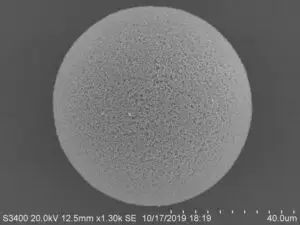
Résine de chromatographie Biovanix InertShell is a revolutionary core-shell technology-based resin designed for the purification of viruses and large biomolecules. Combining size-exclusion separation with binding chromatography, this advanced resin efficiently captures and isolates large biomolecules while allowing smaller contaminants to pass through and bind within the core.
This dual functionality ensures high-purity outcomes in downstream processing.
20 mg/mL
BSA Binding Capacity
≤1,0 MPa
Pression maximale
pH 3–13
Wide pH Stability
30+
Reuse Cycles
How It Works
Dual-Function Core-Shell Architecture
Combining size-exclusion and binding chromatography in a single resin for unmatched purification efficiency.
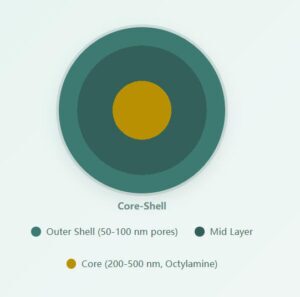
Size-Exclusion + Binding in One Step
The outer shell is hydrophilic and neutral with 50-100 nm pores. Large biomolecules (e.g., inactivated viruses) are too large to penetrate the shell and are collected directly in the flow-through fraction (FT mode).
Smaller contaminants (<700 kDa) diffuse through the shell into the macroporous core (200-500 nm), where octylamine ligands provide both anion exchange and hydrophobic interaction to capture and retain impurities.
Key advantage: The thinner shell layer (0.5-1.0 μm vs. competitor’s 5 μm) enables faster mass transfer of impurities to the core for capture, resulting in higher yield of impurity removal and more efficient CIP cleaning.
Product Features
Designed for Demanding Biopurification
Four key capabilities that set InertShell apart in virus and biomolecule downstream processing.
🔬 Core-Shell Technology
- Double fonctionnalité : Effectue simultanément une séparation par exclusion de taille et une chromatographie d'affinité.
- Séparation efficace : Les biomolécules de grande taille (par exemple, des virus inactivés) sont collectées dans la fraction de percolation (mode FT), tandis que les contaminants (<700 kDa) se lient aux ligands internes.
- Conception optimisée : La coque extérieure est hydrophile et neutre, empêchant les interactions indésirables et garantissant des débits élevés.
⚗️ Advanced Material Composition
- Base de polymère : Fabriqué à partir de microsphères de méthacrylate polymère pour une durabilité robuste et une stabilité chimique.
- Ligand actif : Le ligand octylamine dans le cœur offre à la fois des capacités d'échange anionique et d'interaction hydrophobe.
- Structure poreuse : La coquille a une taille de pores de 50 à 100 nm, tandis que le cœur varie de 200 à 500 nm, assurant une séparation efficace basée sur la taille moléculaire.
✨ High Purity and Efficiency
- Capture sélective : Élimine efficacement les impuretés telles que les protéines de cellules hôtes, les fragments d'ADN, les endotoxines et l'albumine.
- Haute Capacité : Conçu pour gérer des procédés de purification à grande échelle avec une grande efficacité et évolutivité.
🛡️ Compliance and Safety
- Dérivé non animal Manufactured using synthetic processes, ensuring compliance with regulatory standards and ethical requirements.
- Performances stables Fiable sur différentes échelles de production, garantissant des résultats constants.
Technical Specifications
Complete Product Specifications
Detailed technical data for method development, validation, and process integration.
| Caractéristique | Description |
|---|---|
| Matrice de soutien | Poly(styrène-divinylbenzène) réticulé |
| Taille moyenne des particules | 50-150 μm |
| Taille moyenne des pores | 200 nm (core); 50-100 nm (shell) |
| Fonctionnalité de surface | poly(dT) 25-mère avec lieur propriétaire |
| Densité du ligand | 0,10-0,20 mmol/mL |
| Résistance mécanique | 70 bars (1 000 psi ; 7 MPa) |
| Stabilité thermique | Allows sample denaturing at 65°C if needed |
| Gamme de pH | 2-13 |
| Gamme de force ionique | 0 à 5 M, tous les sels courants |
| Résistance chimique | Common agents for mRNA purification, include 0.5 M NaOH, 2 M MgCl₂, 20 mM EDTA. Water, 0 to 100% alcohol, acetonitrile, 2 M acetic acid, 1 M HCl, and other common organic solvents |
| Stockage | 18-20% éthanol |
Competitive Edge
Biovanix InertShell vs. Competitor 700
Direct performance comparison demonstrates clear advantages across key parameters.
| Coque inerte Biovanix | Concurrent 700 | |
| Matrice | Polyacrylate | Agarose hautement réticulé |
| Ligand | Octylamine | Octylamine |
| Taille moyenne des particules | 50-150 μm | 50-150 μm |
| Densité du ligand | 0,10-0,20 mmol/mL | 0,04-0,085 mmol/mL |
| Capacité de liaison¹ | 20 mg d'albumine sérique bovine/mL de résine | 12 mg BSa/mL résine |
| Pression de fonctionnement | ≤1,0 MPa | ≤0,3 MPa |
| Débit opérationnel | 100-600 cm/h | 100-600 cm/h |
| Stabilité du pH | 3-13 | 3-13 |
| Température | 4-30℃ | 4-30℃ |
| Stabilité chimique | Tous les tampons aqueux couramment utilisés : hydroxyde de sodium (NaOH) à 1 M², chlorhydrate de guanidine à 6 M, isopropanol 30% et éthanol 70%. | |
| Stockage | Éthanol 20% entre 4 °C et 25 °C | |
- Capacité de liaison dynamique mesurée au moment de la percée à 51 TP3T, à un débit de 76 cm/h, sur des colonnes de φ 10 × 13 mm et d'une capacité de 1 ml. Le tampon était composé de 1,0 mg/ml de BSA dans une solution de NaCl à 50 mM, pH 0.
- Aucun changement significatif de la capacité ionique et de la teneur en carbone après un stockage d'une semaine dans du NaOH 1 M à 25°C.
2.5×
1.67×
3.3×
Thinner Shell, Faster Mass Transfer
Compared with Competitor 700, the thickness of the core in Biovanix InertShell (0.5-1.0 μm) is significantly smaller than Competitor 700 (5 μm). This thinner shell is conducive to the rapid mass transfer of impure proteins to the medium core for capture, including host cell proteins, DNA fragments, endotoxin, and serum. Biovanix InertShell delivers a higher yield of impurity removal. With the macroporous structure (200-500 nm) of the core, InertShell can quickly remove captured impurities during CIP, and demonstrates a longer service life — in animal vaccine studies, consistent performance for more than 30 reuse cycles.
Avantages en un coup d'œil
Why Biovanix InertShell Resin
Purpose-built for high-purity virus and biomolecule downstream processing.
⚡
Haute efficacité
Purification rapide et efficace de l'ARNm.
📈
Procédé évolutif
Facilement adaptable à la fabrication à grande échelle.
🛡️
Conformité réglementaire
Procédé de fabrication non dérivé d'animaux et synthétique.
💰
Rentable
Un flux de travail simplifié réduit la complexité opérationnelle et les coûts.
🔄
Long Service Life
30+ reuse cycles with consistent performance.
Applications
Built for the Future of Biopharmaceuticals
From vaccine production to gene therapy, InertShell supports your most critical purification workflows.
Purification de virus
Isolement efficace des virus inactivés pour les vaccins et les thérapies géniques.
Séparation de Grandes Biomolécules
Convient à la purification de grandes protéines et de complexes.
Élimination des protéines de la cellule hôte
Élimination efficace des protéines de cellules hôtes et autres impuretés.
Production de vaccins
Optimisation des procédés de purification en aval pour les vaccins à ARNm et les vaccins à base de vecteurs viraux.
Thérapie génique
Production évolutive de vecteurs viraux pour les applications de thérapie génique.
Why Choose Biovanix
Your Trusted Partner in Chromatography
① Enhanced Purity
Élimination efficace des impuretés pour atteindre une ultra-haute pureté dans la purification de virus et de biomolécules.
② Dual Mode Operation
Combine la chromatographie d'exclusion de taille et la chromatographie d'affinité pour un contrôle polyvalent et précis.
③ Scalable Solution
Idéal pour les processus de fabrication à l'échelle du laboratoire et à grande échelle.
④ Cost-Effective
Des processus simplifiés et une efficacité élevée réduisent les coûts opérationnels et améliorent la productivité.
⑤ Regulatory Compliance
La fabrication à partir de composants d'origine non animale et synthétiques garantit le respect des normes biopharmaceutiques internationales.
Frequently Asked Questions
InertShell Resin FAQ
Common questions about core-shell chromatography for virus and biomolecule purification.
What is InertShell Core-Shell Chromatography Resin and how does it work?
Biovanix InertShell is a core-shell chromatography resin designed for the purification of viruses and large biomolecules. It combines size-exclusion separation with binding chromatography in a single step. The outer shell is hydrophilic and neutral with 50-100 nm pores, while the inner core features macropores of 200-500 nm functionalized with octylamine ligands. Large biomolecules like inactivated viruses pass through in the flow-through fraction, while smaller contaminants (<700 kDa) including host cell proteins, DNA fragments, and endotoxins bind to the internal ligands.
What is the difference between core-shell and fully porous chromatography resins?
Core-shell resins feature a non-porous solid core surrounded by a thin porous outer shell. This architecture reduces mass transfer resistance compared to fully porous particles, enabling faster flow rates with lower backpressure. The reduced diffusion path means analytes spend less time diffusing in and out of pores, resulting in sharper peaks, higher resolution, and shorter processing times. Biovanix InertShell further enhances this by using a polymeric methacrylate base rather than silica, providing superior chemical stability across pH 3-13.
What applications is InertShell resin best suited for?
InertShell resin is optimized for five key applications: (1) Virus purification — efficient isolation of inactivated viruses for vaccines and gene therapies; (2) Large biomolecule separation — purification of large proteins and complexes; (3) Host cell protein (HCP) removal — efficient elimination of HCPs and other process impurities; (4) Vaccine production — streamlined downstream processing for mRNA vaccines and viral vector-based vaccines; (5) Gene therapy — scalable production of viral vectors. It is particularly suited for adenovirus (ADV) purification.
How does InertShell compare to competing core-shell resins?
Compared to Competitor 700 (agarose-based), Biovanix InertShell offers several advantages: (1) 1.67× higher binding capacity (20 mg BSA/mL vs. 12 mg BSA/mL); (2) 3.3× higher operational pressure tolerance (1.0 MPa vs. 0.3 MPa); (3) 2.5× higher ligand density (0.10-0.20 mmol/mL vs. 0.04-0.085 mmol/mL); (4) Thinner shell layer (0.5-1.0 μm vs. 5 μm) enabling faster mass transfer of impurities to the core for capture; (5) Polymeric methacrylate base provides greater chemical stability than agarose; (6) Demonstrated reusable performance of 30+ cycles with minimal property changes in animal vaccine applications.
What is the recommended flow rate for InertShell resin?
Biovanix InertShell supports operational flow rates of 100-600 cm/h at pressures up to 1.0 MPa (approximately 10 bar). The rigid polymeric methacrylate matrix maintains structural integrity even at elevated flow rates. Users should adjust flow rate depending on the specific application and performance requirements, while ensuring the upper pressure limitation is not exceeded. The core-shell architecture ensures efficient mass transfer even at high linear velocities.
Can InertShell resin be reused, and how do I clean it?
Yes, InertShell resin is designed for multiple reuse cycles. The resin demonstrates excellent chemical stability and can withstand cleaning with 1 M NaOH (no significant changes in ionic capacity and carbon content after 1 week storage in 1 M NaOH at 25°C), 6 M guanidine hydrochloride, 30% isopropanol, and 70% ethanol. The macroporous core structure (200-500 nm) enables rapid removal of captured impurities during CIP. In animal vaccine purification studies, the resin has been demonstrated to maintain consistent performance over 30+ reuse cycles.
What buffer and storage conditions are required?
InertShell resin is compatible with all commonly used aqueous buffers, 1 M NaOH, 6 M guanidine hydrochloride, 30% isopropanol, and 70% ethanol. It operates across a pH range of 3-13 and ionic strength range of 0 to 5 M. Operating temperature range is 4-30°C. For storage, keep the resin in 20% ethanol at 4°C to 25°C. Do not expose to strong oxidizers (hypochlorite), oxidizing acids (nitric acid), strong reducing agents (sulfite), acetone, THF, or benzyl alcohol.
How does InertShell achieve dual functionality in size-exclusion and binding chromatography?
InertShell achieves dual functionality through its unique core-shell architecture. The outer shell is hydrophilic and neutral with small pores (50-100 nm), which prevents large biomolecules like viruses from entering and interacting with the surface. These large molecules are collected in the flow-through fraction (FT mode). Meanwhile, the inner core has large macropores (200-500 nm) functionalized with octylamine ligands that provide both anion exchange and hydrophobic interaction capabilities, capturing smaller contaminants (<700 kDa) including host cell proteins, DNA fragments, endotoxins, and albumin.
Is InertShell resin suitable for GMP manufacturing?
Yes, InertShell resin is manufactured using synthetic processes and is non-animal derived, ensuring compliance with regulatory standards and ethical requirements. This makes it suitable for use in GMP manufacturing environments for vaccine production and gene therapy applications. The consistent performance across various production scales and the demonstrated reusability (30+ cycles) support cost-effective and compliant large-scale biopharmaceutical manufacturing.
What particle size does InertShell use and why does it matter?
InertShell resin uses particles with an average size of 50-150 μm. The core-shell design within each particle is key: the thin outer shell (0.5-1.0 μm thickness) with small pores creates the size-exclusion effect for large biomolecules, while the macroporous core provides high-capacity binding for smaller impurities. This dual-size architecture within each particle enables the simultaneous size-based separation and affinity-based capture that distinguishes InertShell from conventional single-mechanism resins.
How does InertShell compare to agarose-based resins for virus purification?
InertShell’s polymeric methacrylate base offers significant advantages over traditional agarose-based resins: (1) Higher mechanical strength — supports pressures up to 1.0 MPa vs. 0.3 MPa for agarose, enabling faster processing; (2) Wider chemical compatibility — stable with NaOH, guanidine hydrochloride, organic solvents; (3) Higher binding capacity — 20 mg BSA/mL vs. 12 mg BSA/mL; (4) Higher ligand density — 0.10-0.20 mmol/mL vs. 0.04-0.085 mmol/mL; (5) Longer service life — demonstrated 30+ reuse cycles with consistent performance; (6) Faster mass transfer — thinner shell layer (0.5-1.0 μm vs. 5 μm) allows quicker impurity capture and CIP cleaning.
What impurities can InertShell resin remove from my sample?
InertShell resin effectively removes a broad range of process-related impurities while retaining your target large biomolecules in the flow-through: (1) Host cell proteins (HCPs); (2) DNA fragments; (3) Endotoxins; (4) Albumin; (5) Other contaminants smaller than 700 kDa. The octylamine ligand in the core provides both anion exchange and hydrophobic interaction mechanisms, enabling multi-modal impurity capture. This comprehensive impurity removal in a single step significantly simplifies downstream processing workflows.
Produits similaires
Complete Chromatography Solutions from Biovanix
Pair Oligo dT(25) Resin with our full range of chromatography hardware, media, and systems.
Milieux de chromatographie en agarose
High-performance agarose-based resins for protein and biomolecule purification
Supermacroporous Polymer Microspheres
Rigid PS-DVB microspheres for high-flow chromatography applications
Silica Gel Packing Material
Ultra-pure silica gel for HPLC and flash chromatography
Prepacked HPLC Columns
Ready-to-use analytical and preparative columns
Empty HPLC Column Tubing
Stainless steel and PEEK empty columns for self-packing
Isoplex Column Packer
Precision column packing system for reproducible results
Colonne de chromatographie en verre
Double-layer glass columns for low-pressure purification
Système de filtration à flux tangentiel
Automated TFF for concentration and buffer exchange
Ready to Transform Your Virus Purification Workflow?
Contact our application scientists for personalized technical support, sample testing, or volume pricing on InertShell resin.
 English
  العربية
  Français
  Deutsch (Sie)
  한국어
한국어  Русский
  Español de Argentina