
Oligo dT(25) Resina de cromatografía de afinidad
Resina de afinidad Biovanix Oligo dT(25) es una solución de vanguardia diseñada para la purificación y el aislamiento de ARNm a partir de procesos de fabricación de transcripción in vitro (TIV). Esta resina avanzada captura selectivamente el ARNm a través de su cola poliadenilada (poliA), separándolo eficazmente de otros componentes de la reacción de transcripción, como las enzimas y el ADN plasmídico.
Perfectamente adecuado para la purificación a gran escala, Resina de afinidad Biovanix Oligo dT(25) es un factor clave para las aplicaciones de vacunas y terapia génica, ya que ofrece una selectividad y una capacidad inigualables para satisfacer las exigencias de la fabricación biofarmacéutica moderna.
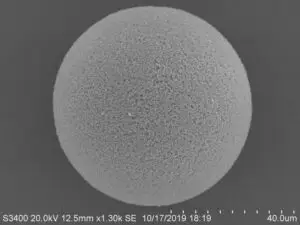
50 μm
Tamaño de las partículas
200 nm
Tamaño de poro
pH 2–13
Stability Range
Presión máxima
Stability Range
Características del producto
Engineered for High-Performance mRNA Purification
Biovanix Oligo dT(25) Affinity Resin combines selective polyA capture with a rigid PS-DVB matrix for reliable results at any scale.
1. Captura selectiva de ARNm
✔ PolyA Tail Specificity: Se dirige al ARNm con gran selectividad, garantizando la eliminación eficaz del ADN plasmídico y otros componentes de la IVT.
✔Simple Salt and Water Elution: Proceso de purificación racionalizado con una complejidad mínima.
2. Solución escalable
✔ Excelente escalabilidad: Diseñada para pasar sin problemas de la producción a escala de laboratorio a la producción a gran escala.
✔ High Capacity: Satisface las exigencias de la fabricación de ARNm de alto rendimiento.
3. Derivados no animales
✔ Proceso de fabricación sintético: Los oligoligandos Biovanix no contienen componentes animales, lo que garantiza el cumplimiento de los requisitos reglamentarios y las normas éticas.
4. Flujo de trabajo simplificado
✔ Complejidad reducida: Elimina la necesidad de múltiples pasos de purificación, maximizando la eficiencia y reduciendo la complejidad del procesamiento posterior.
✔ Rendimiento constante: Resultados fiables en diferentes escalas y lotes de producción.
How It Works
Simple 4-Step mRNA Purification Workflow
From crude IVT mixture to purified mRNA in a single affinity capture step — no complex multi-step protocols required.
①
Equilibrate
Prepare column with high-salt binding buffer (e.g., 0.5 M NaCl)
②
Load & Bind
Apply IVT mixture; polyA-tailed mRNA binds to poly(dT) ligands
③
Wash
Remove impurities (enzymes, pDNA, nucleotides) in flow-through
④
Elute
Release purified mRNA with water or low-salt buffer
Technical Specifications
Product Specifications
Comprehensive technical data for method development and process validation.
| Característica | Descripción |
| Matriz de apoyo | Poli(estireno-divinilbenceno) reticulado |
| Tamaño medio de las partículas | 50 um |
| Tamaño medio de los poros | 200 nm |
| Funcionalidad de la superficie | poly(dT) 25mer con enlazador patentado |
| Densidad del ligando | 0,3 umol/ml |
| Resistencia mecánica | 70 bar (1.000 psi; 7 MPa) |
| Estabilidad térmica | permite la desnaturalización de la muestra a 65°C si es necesario |
| Rango de pH | 2-13 |
| Gama de fuerza iónica | 0 a 5 M, todas las sales comunes |
| Resistencia química | Los agentes comunes para la purificación de ARNm, incluyen NaOH 0,5 M, 2 M MgCl2, 20 mM EDTA. Agua, alcohol de 0 a 100%, acetonitrilo, ácido acético 2 M, HCl 1 M y otros disolventes orgánicos comunes. |
| Almacenamiento | 18-20% etanol |
Resistencia química y térmica
| Rango de pH | 2-13 |
| Gama de fuerza iónica | 0 a 5 M, todas las sales comunes |
| Aditivos tampón | Los agentes comunes para la purificación de ARNm incluyen NaOH 0,5 M, 2 MMgCl2, 20 mM EDTA. No exponer a oxidantes fuertes (como el hipoclorito), ácidos oxidantes (como el nítrico), agentes reductores fuertes (como el sulfito), acetona, THF o alcohol bencílico. |
| Disolventes | Agua, alcohol de 0 a 100%, acetonitrilo, ácido acético 2 M, HCl 1 M y otros disolventes orgánicos comunes. No exponer a oxidantes fuertes (como el hipoclorito), ácidos oxidantes (como el nítrico), agentes reductores fuertes (como el sulfito), acetona, alcohol bencílico o THF. |
| Caudal | Ajustar el caudal en función del rendimiento. No sobrepasar los límites superiores de presión. |
Resumen de prestaciones
Why Biovanix Oligo dT(25) Resin
Designed to maximize purity, simplify workflows, and reduce total cost of ownership.
⚡
Alta eficacia
Purificación rápida y eficaz del ARNm.
📈
Proceso escalable
Fácilmente adaptable a la fabricación a gran escala.
🛡️
Cumplimiento de la normativa
Proceso de fabricación no derivado de animales y sintético.
💰
Rentable
La simplificación del flujo de trabajo reduce la complejidad operativa y los costes.
Aplicaciones
Built for the mRNA Revolution
From vaccine development to gene therapy manufacturing, Biovanix Oligo dT(25) Resin supports the full spectrum of mRNA applications.
Producción de vacunas
Purificación eficaz de vacunas de ARNm.
Terapia génica
Producción escalable de ARNm para aplicaciones terapéuticas.
Fabricación IVT
Aislamiento racionalizado de ARNm a partir de mezclas de reacción de transcripción.
Extracción de ADN plasmídico
Eliminación eficaz del ADN plasmídico y otros componentes de la IVT.
Why Choose Biovanix
Your Trusted Partner in mRNA Purification
① Efficient mRNA Purification
Obtenga ARNm de alta pureza con impurezas mínimas.
② Cost-Effective
La reducción de la complejidad operativa y el aumento de la productividad reducen los costes generales de producción.
③ Regulatory Compliance
La fabricación no derivada de animales y sintética garantiza el cumplimiento de las normas mundiales.
④ Versatile Application
Ideal para una amplia gama de construcciones de ARNm utilizadas en vacunas, terapias génicas y otros productos biofarmacéuticos.
Frequently Asked Questions
Oligo dT(25) Resin FAQ
Common questions about mRNA purification with Oligo dT(25) affinity chromatography.
What is Oligo dT(25) affinity chromatography resin and how does it work?
Oligo dT(25) affinity chromatography resin is a specialized chromatography medium functionalized with poly(deoxythymidine) 25-mer ligands attached to a solid support matrix. It works through complementary A-T base pairing: the poly(dT) ligands on the resin selectively bind to the polyadenylated (polyA) tail of mRNA molecules. When an IVT (in vitro transcription) mixture is loaded onto the column under high-salt conditions, mRNA is captured while impurities such as enzymes, plasmid DNA, and unincorporated nucleotides pass through. Elution is achieved with water or low-salt buffer, releasing the purified mRNA.
What is the principle behind mRNA purification using oligo dT affinity chromatography?
The purification principle relies on specific Watson-Crick A-T base pairing between the poly(dT) 25-mer ligand immobilized on the resin and the polyA tail present on mature mRNA. Under high ionic strength conditions (typically 0.5 M NaCl), electrostatic shielding stabilizes the hybridization between poly(dT) and polyA. The mRNA binds selectively to the resin while process impurities flow through. Elution is performed under low-ionic-strength conditions (water or dilute buffer), which destabilizes the hybrid and releases purified mRNA in a single chromatographic step.
What types of mRNA can be purified with Oligo dT(25) resin?
Oligo dT(25) resin can purify any polyadenylated mRNA produced through in vitro transcription (IVT), including mRNA constructs for vaccines (such as infectious disease vaccines), gene therapy mRNAs (such as those encoding therapeutic proteins or gene editing components), and research-grade mRNAs of various lengths. The resin is compatible with mRNA constructs ranging from short transcripts to several thousand nucleotides in length, as long as they contain a polyA tail.
What is the binding capacity of Oligo dT(25) resin?
The binding capacity of Oligo dT(25) resin depends on the mRNA construct length, loading conditions, and the specific product formulation. Generally, affinity resins with poly(dT) ligands offer high dynamic binding capacity suitable for preparative-scale mRNA purification. Smaller mRNA constructs tend to achieve higher binding capacity per mL of resin due to reduced steric hindrance. For specific capacity data for your mRNA construct, contact the Biovanix technical team for application-specific recommendations.
What are the advantages of PS-DVB matrix vs. agarose for mRNA purification?
Poly(styrene-divinylbenzene) (PS-DVB) matrices offer several advantages over traditional agarose gels for mRNA purification: (1) Higher mechanical strength — PS-DVB beads are rigid, enabling higher flow rates and pressure tolerance (up to 70 bar for Biovanix resin) without bed compression; (2) Broader chemical compatibility — stable across pH 2–13 and resistant to organic solvents, enabling aggressive cleaning-in-place (CIP) with NaOH; (3) Longer resin lifetime — the rigid polymer backbone does not compress or degrade over repeated cycles; (4) Better scalability — linear pressure-flow behavior allows consistent performance from lab to production scale; (5) No risk of gel compression artifacts during scale-up.
How do I pack and use Oligo dT(25) resin in my chromatography system?
General workflow: (1) Equilibrate the column with binding buffer (high-salt buffer, e.g., 0.5 M NaCl) to prepare the resin for mRNA capture; (2) Load the IVT reaction mixture onto the column — the mRNA polyA tail binds to the poly(dT) ligands while impurities flow through; (3) Wash the column with binding buffer or a moderate-salt wash buffer to remove residual impurities; (4) Elute purified mRNA with water or low-salt buffer (e.g., 10 mM Tris-HCl); (5) Clean and regenerate the column with appropriate CIP solution (e.g., 0.1–0.5 M NaOH) for reuse. Always adjust flow rate to stay within the pressure limit (70 bar maximum for Biovanix resin). For denaturing secondary structures, samples can be heated to 65°C during processing.
What flow rate and pressure should I use with Oligo dT(25) resin?
Biovanix Oligo dT(25) resin has a maximum mechanical resistance of 70 bar (1,000 psi / 7 MPa). The flow rate should be adjusted based on your specific application and column dimensions, ensuring that backpressure does not exceed this limit. The 50 μm average particle size allows efficient mass transfer at moderate to high linear flow rates. Start at a conservative flow rate during method development and optimize based on binding efficiency and recovery. The rigid PS-DVB matrix maintains stable bed volume across flow rate changes, providing consistent performance.
Can I reuse the Oligo dT(25) resin and how do I clean it?
Yes, Oligo dT(25) resin can be reused for multiple purification cycles with proper cleaning and storage. Cleaning-in-place (CIP) is typically performed using 0.1–0.5 M NaOH, which effectively removes residual nucleic acids and contaminants. The resin’s broad pH stability (2–13) and chemical resistance support stringent cleaning protocols. After CIP, re-equilibrate the column with binding buffer before the next use. Store the resin in 18–20% ethanol at 2–8°C when not in use. Do not freeze. Resin lifetime depends on the application, cleaning protocol, and feed material quality.
What buffer conditions are recommended for mRNA binding and elution?
For mRNA binding (capture): use a high-salt buffer such as 0.5 M NaCl with an appropriate buffer component (e.g., 10 mM Tris-HCl, pH 7.5). The high ionic strength provides electrostatic shielding that stabilizes the A-T hybridization between poly(dT) ligands and the mRNA polyA tail. For washing: use the same high-salt binding buffer or a moderately reduced salt concentration. For elution: use deionized water or a low-salt buffer (e.g., 10 mM Tris-HCl without NaCl) to destabilize the hybrid and release purified mRNA. The resin also allows sample denaturing at 65°C if needed to eliminate undesired higher-order RNA structures.
How does Oligo dT(25) resin remove plasmid DNA and other IVT impurities?
The selectivity of Oligo dT(25) resin is based on the specific A-T base pairing between the poly(dT) ligands and the polyA tail of mRNA. Only polyadenylated mRNA molecules bind to the resin. Plasmid DNA (which lacks a polyA tail), RNA polymerase enzymes, unincorporated nucleotides, short abortive transcripts, and buffer components do not bind and are removed in the flow-through and wash fractions. This single-step affinity capture effectively separates full-length mRNA from the major IVT process impurities, significantly reducing downstream processing complexity.
Can Oligo dT(25) resin be used for continuous or automated mRNA purification?
Yes, Oligo dT(25) resin is compatible with standard chromatography systems and can be adapted for automated and continuous processing workflows. The rigid PS-DVB matrix provides consistent pressure-flow behavior, making it suitable for use on automated chromatography platforms. The simple salt-and-water elution workflow minimizes buffer exchange requirements. For process development and screening, smaller column formats can be used to optimize conditions before scaling to larger automated systems. The linear scalability of the PS-DVB matrix ensures that conditions optimized at small scale translate directly to production scale.
What is the shelf life and storage condition for Oligo dT(25) resin?
Biovanix Oligo dT(25) resin should be stored in 18–20% ethanol solution. The recommended storage temperature is 2–8°C (refrigerated). Do not freeze the resin, as freezing may damage the bead structure. When properly stored, the resin maintains its performance characteristics over extended periods. Before use, ensure the resin is at room temperature and thoroughly equilibrated with binding buffer. Refer to the product certificate of analysis for specific shelf-life information for your lot.
Testimonio de un cliente
Trusted by Biopharma Professionals
"La resina cromatográfica Biovanix InertShell ha transformado nuestro proceso de purificación de virus. La doble funcionalidad y la alta selectividad han mejorado significativamente nuestros rendimientos y niveles de pureza, convirtiéndola en una herramienta esencial en nuestros ensayos."
- Alex, Desarrollador, AA Biopharma
Productos relacionados
Complete Chromatography Solutions from Biovanix
Pair Oligo dT(25) Resin with our full range of chromatography hardware, media, and systems.
Medio de cromatografía de agarosa
High-performance agarose-based resins for protein and biomolecule purification
Supermacroporous Polymer Microspheres
Rigid PS-DVB microspheres for high-flow chromatography applications
Silica Gel Packing Material
Ultra-pure silica gel for HPLC and flash chromatography
Prepacked HPLC Columns
Ready-to-use analytical and preparative columns
Empty HPLC Column Tubing
Stainless steel and PEEK empty columns for self-packing
Empaquetador de columna Isoplex
Precision column packing system for reproducible results
Columna de cromatografía de vidrio
Double-layer glass columns for low-pressure purification
Sistema de Filtración de Flujo Tangencial
Automated TFF for concentration and buffer exchange
Ready to Optimize Your mRNA Purification?
Contact our application scientists for personalized technical support, sample testing, or volume pricing.
 English
  العربية
  Français
  Deutsch (Sie)
  한국어
한국어  Русский
  Español de Argentina